An International Scientific Committee of
ICOMOS

ICICH News

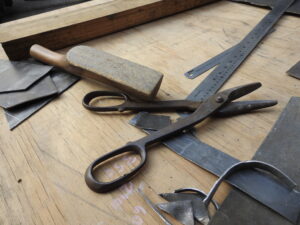
Talking Intangibles with Traditional Trades: Copper, Lead, Slate & Stone

Join the Australia ICOMOS National Scientific Committee Intangible Cultural Heritage and our panel of experts to discuss how Intangible Cultural Heritage (ICH) can inform high quality conservation outcomes.
 
Wednesday, 25th September @5-6pm AEST via Zoom 
 
The first in a series of conversations with Traditional Tradespeople, we will be joined by conservation stonemason James Charlwood and heritage roof plumber Rob Jones to hear about the ways ICH informs their daily practice in the historic built environment.  
 
 
Continue Reading

Call for Abstracts: Heritage Ecosystem and Authenticity

The deadline for submitting abstracts for the international symposium, The Further Evolution of Authenticity through the Lens of Heritage Ecosystems has been extended until September 3 (Tuesday), 2024.

The symposium will be held in Takasaki, Japan, on January 10 and 11, 2025, and aims to explore the challenges we face by focusing on the concept of a heritage ecosystem. A heritage ecosystem is understood to encompass the cyclical and organic relationships among various elements that constitute the rich cultural and natural environment of the region and that are connected to the heritage. Because challenges to heritage are ever-changing, the concept of a heritage ecosystem offers a powerful framework for better coping with the challenges that confront us today and those to come.

Read the full call for papers on the website. 

Continue Reading

1 June 2022 Film screening: Something can only be danced!

A Poetic Documentary about Tibetan Ritual Mask Dance, Cham, by Aase-Hilde Brekke. 

1 June, 2022 15:00 – 17:00
Pilestredet, Oslo

Brekke will talk about how these particular dances are performed in honour of the Indian Guru and master Padmasambhava, also referred to as The second Buddha. The dances shows both wrathful and peaceful dances, originally a copy of the celestial beings. The dances are believed to bring purifications and blessings for the surroundings, and train the dancers and the spectators to meet the different Bardo-stages in death.

The monastery Tashi Jong in Tibet is well known for their elaborate dances, and they perform the dances four times a year. Due to the exile situation for the Tibetan refugees, they have lost a lot of costumes, masks and the religious texts as well.

As part of the programme, Brekke will also present ICOMOS’ work, and Eivind Falk will talk about ICOMOS’ and UNESCO’s work on Intangible Heritage.

Arranged by:  The research group Philosophy, Art and Culture, OsloMet, Oslo, Norway.

Click here to learn more


The Mask dance of the drums from Drametse was inscribed in 2008 (3.COM) on the Representative List of the Intangible Cultural Heritage of Humanity (originally proclaimed in 2005) 

Continue Reading

Call for Applications: Endangered Material Knowledge Programme

The programme offers small and large grants to document material knowledge systems that are under threat and in danger of disappearing. This includes knowledge systems associated with the making, use, repair and re-purposing of material objects, spaces, architecture, performances and environments. In order to qualify for these grants, these knowledge systems must still be actively pursued, or at least practiced within living memory of the knowledge holders. EMKP does not support work to revitalise a lost or forgotten tradition.

Small Grants can last up to one year with a maximum award of £15,000. Small Grants are intended for projects that are focused on a specific/individual material practice and which are limited in scope. They are also suitable for initial pilot work to establish the nature and extent of material knowledge systems where these might not be previously known, or for early career applicants who are building new projects.

Large Grants can last up to two years with a maximum award of £70,000. Large Grants are suitable for mature projects where intensive and more diverse documentation is proposed, a larger team is needed, multiple strands of work are happening simultaneously and/or more time is needed to complete the documentation (e.g. because of seasonal cycles of working)

Documentation methods can include, but are not limited to, film, audio recordings, photographs, written notes, maps, 3D images, and drawings. Successful applicants must agree to submit digital copies of these records to the British Museum’s EMKP digital repository, which is open access.

Applicants from across the world can apply for grants irrespective of nationality, although they must be affiliated to an institution that can provide independent oversight and reports to EMKP. There is no restriction on where the proposed work can be carried out; however, strong preference is given to projects in regions and countries where there is limited financial support available for research.

Learn how to apply on the programme’s website.

Continue Reading

ICOMOS India (NE) and ICICH Hold Webinar, “Bihu : An Agrarian Festival of Assam”

On 20 September, 2020, ICOMOS India (North East Zone) in association with ICICH hosted the webinar on “Bihu: An Agrarian Festival of Assam.” Highlights of the webinar included the following presentations:

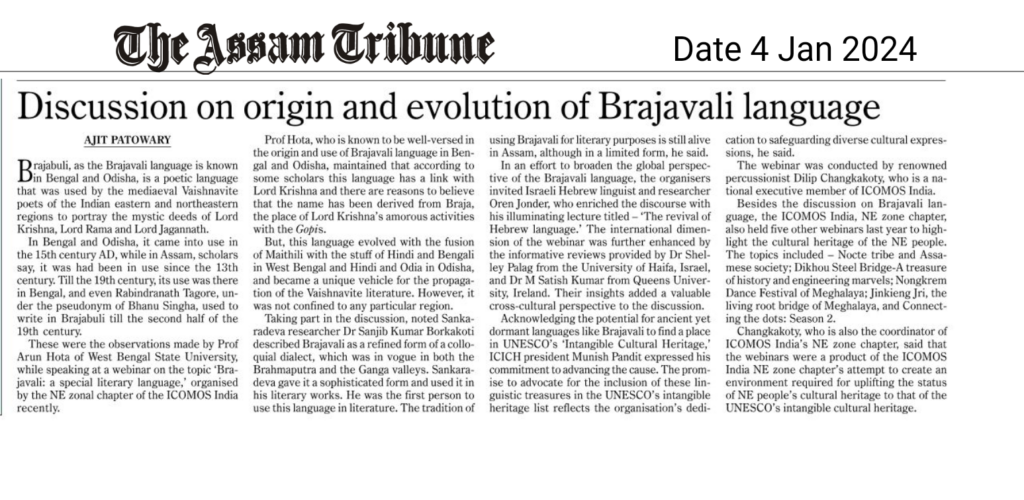
The event was covered in an article published by the Assam Tribune.

Videos

View examples of the intangible heritage related to the festival:

Celebration of the Kati Bihu festival of Assam at the Auniati Sattrat, Majuli, 17 October 2020. Photographs by Samiran Goswai

Continue Reading

Webinar on The Wheel Chart of Sustainability and ICH – 5 November

Thursday 5th November 2020, 14:00-16:00 Helsinki time on ZOOM

Organized by the Finnish Heritage Agency

What does sustainable development mean in practice? How can it be better taken into account while working with living traditions? What can I and my organization do more for a better world?

Learn more about the relation of sustainable development and living heritage. You will also learn how to use the wheel chart in your own work.

The workshop is in English, it is free and open for all. It is intended for anyone working in the field of culture, for NGOs, museums, researchers, educators, government organisations, entrepreneurs…

Learn more and print out your own Wheel Chart from our website.

Register by the 29th Oct the latest to receive the link to participate: https://ssl.eventilla.com/wheelchart

La Finnish Heritage Agency organise un atelier en ligne le 5 novembre 2020 après-midi, sur inscription, autour de la “Wheel Chart of Sustainability and Intangible Cultural Heritage“, support de sensibilisation et de formation aux liens entre patrimoine culturel immatériel & développement durable.

Traduit en français par le ministère de la Culture (DGP – DPRPS), l’outil peut être téléchargé en ligne : https://www.aineetonkulttuuriperinto.fi/en/article/kestavan-kehityksen-kompassi-ja-aineeton-kulttuuriperinto

Continue Reading

Entrevista – Nivaldo Andrade, Antonio Arantes e Leonardo Castriota, sobre o primeiro ano de existência do Fórum de Entidades em Defesa do Patrimônio Cultural Brasileiro

Há um ano, em 10 de outubro de 2019, foi criado o Fórum de Entidades em Defesa do Patrimônio Cultural Brasileiro. O momento era o da realização do 21º Congresso Brasileiro de Arquitetos, em Porto Alegre, e o contexto era o de repúdio às investidas do Governo Federal contra o IPHAN, o Instituto do Patrimônio Histórico e Artístico Nacional, sobretudo a partir de 2016 e na forma da exoneração de técnicos experientes e da substituição de muitos dos seus 27 Superintendentes por pessoas desqualificadas na área. Fato que culminou com a nomeação de Larissa Peixoto, graduada em Turismo e Hotelaria, para a presidência do instituto em maio de 2020, precedida pela exoneração em dezembro de 2019 da presidente Kátia Bogéa, que por 30 anos havia sido Superintendente do IPHAN no Maranhão. Com a extinção do Ministério da Cultura, em janeiro de 2019, o IPHAN passou a ser vinculado ao Ministério do Turismo.

Continue Reading

Online debate “Food and Cultural Heritage: an EU Policy Perspective”

In the frame of the “Food is Culture” cooperation project co-funded by the EU Creative Europe programme, Europa Nostra – the European Voice of Civil Society committed to cultural heritage – and Slow Food – the international movement to prevent the disappearance of local food cultures and traditions – released  an EU policy brief on Food & Cultural Heritage ahead of World Food Day on 16 October.   

Policy brief

Executive Summary 

SAVE THE DATE!

The policy brief on Food & Cultural Heritage will be presented on the occasion of the online debate “Food and Cultural Heritage: an EU Policy Perspective” on Tuesday 17 November from 11:00 to 13:00 CET, taking place in the frame of Slow Food’s Terra Madre Salone del Gusto 2020. 

The debate will include a presentation of the art exhibition “What you didn’t know existed. Endangered food from around the world“, which is now available online after having been presented in several cities across Europe. This multimedia artwork aims at raising the public awareness of the richness of our food heritage, which embodies our shared European values, but is also often at risk of disappearing. 

REGISTER TO THE ONLINE DEBATE HERE 

The Food is Culture project is co-funded by the Creative Europe Programme of the European Union, with the contribution of the Fondazione Cassa di Risparmio di Cuneo. It is led by Slow Food with its partners Europa Nostra, Kinookus, Nova Iskra Creative Hub, and Transpond AB.  

Continue Reading

Basic principles and tips for 3D digitisation of cultural heritage published

The Expert Group on Digital Cultural Heritage and Europeana was tasked by the member states of the European Commission to contribute to the development of guidelines on 3D cultural heritage assets. The resulting list of basic principles and tips for 3D digitisation of tangible cultural heritage contains 10 basic principles and a number of tips for each of them geared toward cultural heritage professionals, institutions and regional authorities in charge of Europe’s precious cultural heritage.

Read the guidelines online

Continue Reading